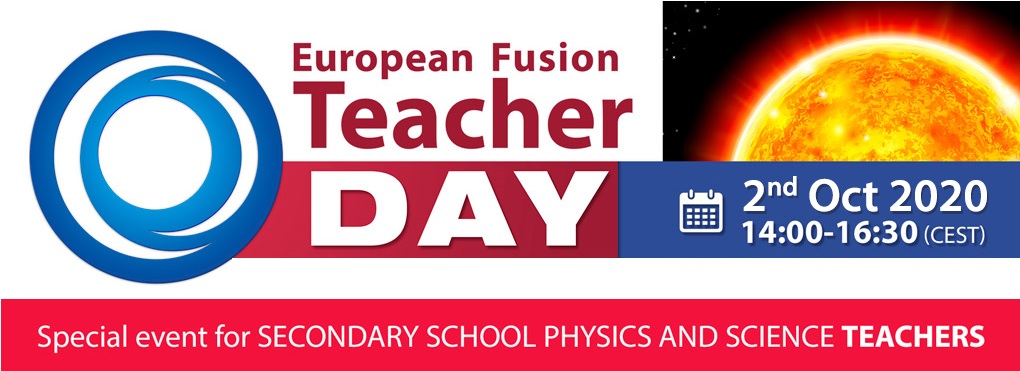
The first-ever edition of FuseNet Teacher’s Day, a Europe-wide webinar dedicated to promoting Fusion in high-schools, was held last Friday, October the 2nd. The event brought together teachers from all around Europe, scattered into 18 local sessions across 16 European Countries. Our BSC Fusion group, in cooperation with Fusion for Energy (F4E), the b_TEC Foundation and the Universitat Politècnica de Catalunya (UPC), organized the Barcelona local session under the umbrella of the FusionCAT project.
We are pleased to announce that our group has been awarded a new research project within the State R&D Program Oriented to the Challenges of the Society 2019 in Spain. It was one of the almost 3000 projects financed by the Ministry of Science and Innovation with a total program budget of 363.13 M€.
Our new project FUSION CODES II is a continuation of our earlier FUSION CODES project (2016-2019) by three more years. As its predecessor, it is directed towards contributing to the development of nuclear fusion as a safe, clean, and virtually limitless energy source for future generations. In particular, it is directed towards ITER, an international nuclear fusion R&D project, which is currently building the world’s largest experimental tokamak nuclear fusion reactor in southern France. ITER aims to demonstrate that fusion energy is scientifically and technologically feasible. It is the bridge towards DEMO, a first fusion energy plant that will demonstrate large-scale production of electricity.
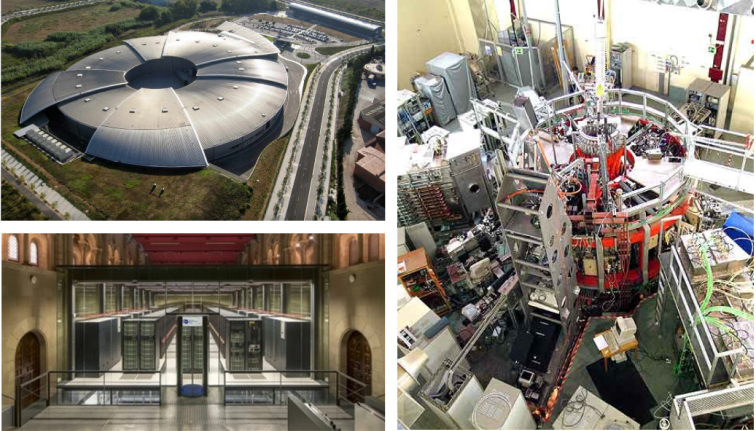
Three of the 29 Unique Scientific and Technical Infrastructures (ICTS) in Spain: Alba synchrotron, TJ-II heliac fusion reactor and MareNostrum supercomputer.
The Unique Scientific and Technical Infrastructures (ICTS) in Spain are facilities, resources and services for the development of top-quality cutting-edge research as well as communication, exchange, and preservation of knowledge, technology transfer, and promotion of innovation. They are either unique or exceptional in their fields, have a high cost of investment, maintenance, and operation, and are of a strategic importance that justifies their availability to all actors in the field of R&D&I.
For example, the Gran Telescopio de Canarias (the Great Telescope of the Canary Islands) is used, among others, to monitor potentially dangerous asteroids and the ALBA synchrotron is used to study the material’s internal structure. They all share three fundamental characteristics: they are infrastructures with public ownership, unique and open to competitive access.
The IAEA Marie Sklodowska-Curie Fellowship Programme (MSCFP) seeks to inspire and support young women to pursue a career in nuclear science and technology, nuclear safety and security, or non-proliferation. The application process has opened for female students interested in applying for a scholarship from the programme towards their Master’s degrees in nuclear science and technology, nuclear safety and security or non-proliferation.
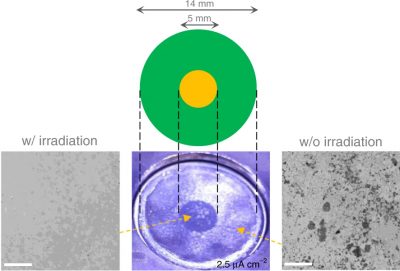
Beam-facing side comparison regions of Ni-20Cr samples. Schematic of the irradiated (in orange) and unirradiated (in green). Zones and SEM images of the beam-facing side of the Ni-20Cr foils after 4 h at 650 °C at a beam current density of 2.5 μA/cm^2. Scale bar: 200 μm. Image adapted from Nat.Comm. 11 (2020) 3430.
Radiation nearly always deteriorates the materials exposed to it, requiring replacement of key components in high-radiation environments such as nuclear reactors. But for certain alloys that could be used in fission or fusion reactors, the opposite turns out to be true: Researchers from MIT and Lawrence Berkeley National Laboratory have now found that instead of hastening the material’s degradation, radiation actually improves its resistance, potentially doubling the material’s useful lifetime. This finding came as a surprise to nuclear scientists and can be potentially used in new fusion reactors designs. The work lead by Weiyue Zhou and Prof. Michael Short have been recently published in Nature Communications.
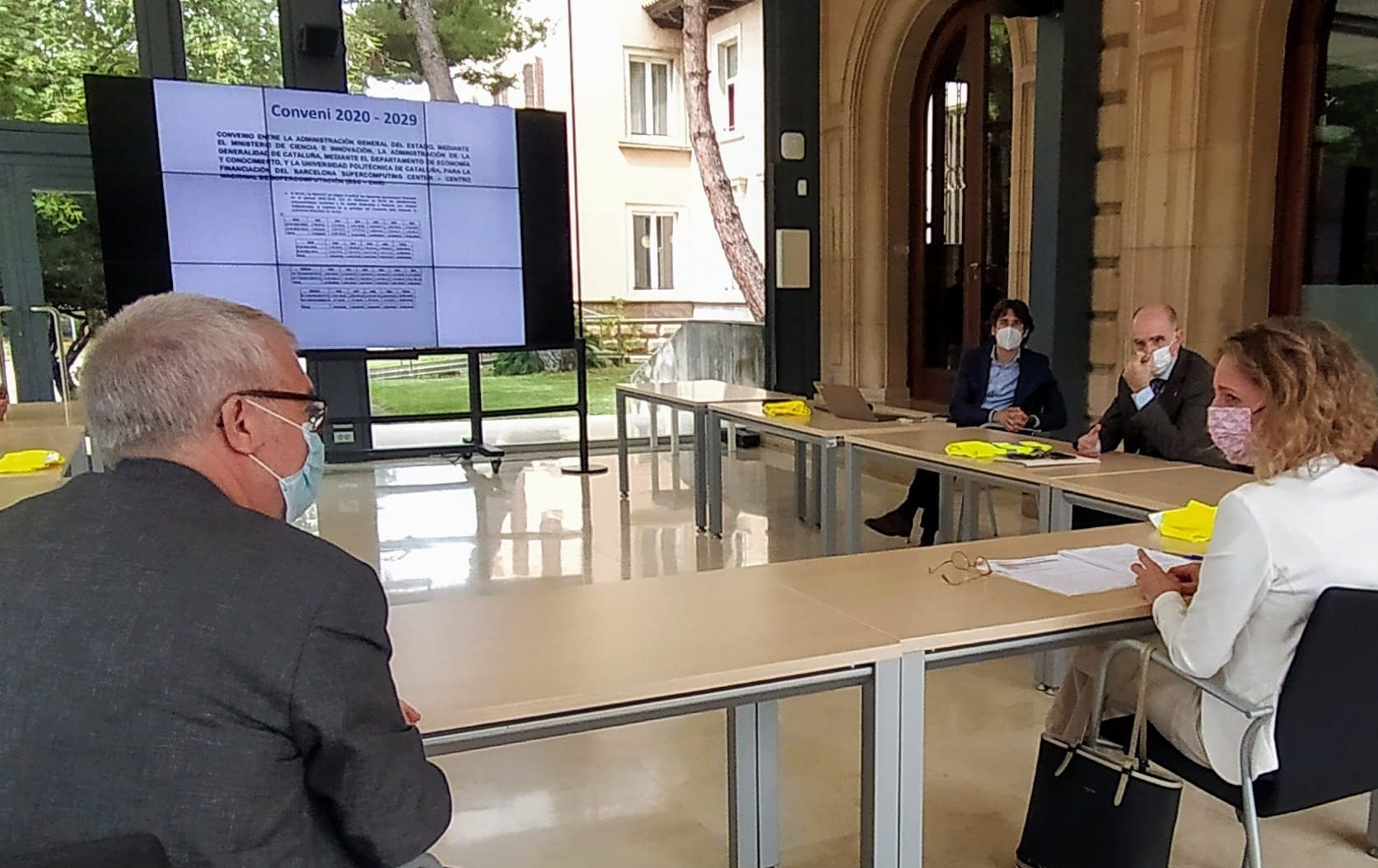
On 16 July, the Catalan Minister Àngels Chacon visited the MareNostrum supercomputer to present the guidelines for the new 2020-2029 agreement that guarantees the financing of the Barcelona Supercomputing Center (BSC). The event was attended by the Secretary of Universities and Research of the Generalitat, Mr Francesc Xavier Grau, and the Rector of the Polytechnic University of Catalonia, Mr Francesc Torres.
The Minister of Business and Knowledge of the Generalitat de Catalunya, Ms Àngels Chacón, explained to the centre’s directors that the Catalan government will contribute 59 million euros to BSC under the agreement with the Spanish Government and the UPC for the period 2020-2029. This agreement has yet to be ratified.