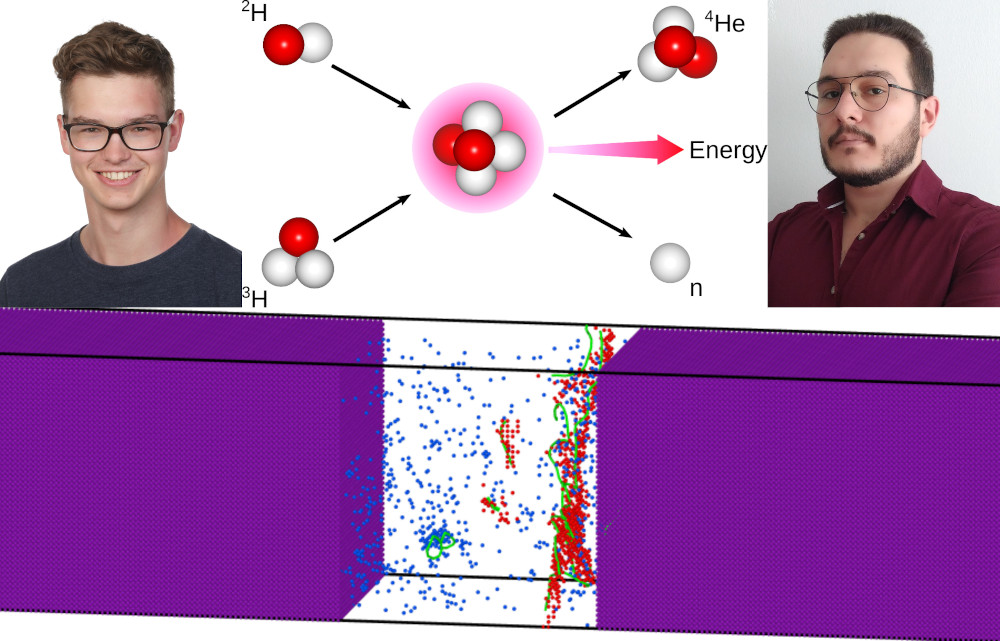
Figure 1: Top: An Illustration of the Fusion Reaction, with our visitors Dominik Freinberger (left) and Arda Erbasan (right), Bottom: Defected simulation box: red, blue, and purple balls represent interstitials, vacancies, and undamaged tungsten atoms, respectively. Dislocation loops and segments are denoted by continuous green lines.
The Fusion Industry Association (FIA), a non-profit advocacy organization representing nearly 30 fusion start-ups, released its second annual report on the state of the global fusion industry this July. The report provides an update on the milestones achieved in the last year by each of 33 companies surveyed as well as an aggregated picture of growth in the industry as a whole using data collected from the companies.
Women in Fusion (WiF) is a global platform to inspire and support women in the Fusion field through sharing experiences, promoting leadership, and encouraging greater recognition for women’s contributions to Fusion. Their website, launched earlier this summer, offers information about the platform and participants of all genders are welcome to join. The website provides community forums for discussion which are open to all registered users as well as information about gender discrepancies in the Fusion workforce.
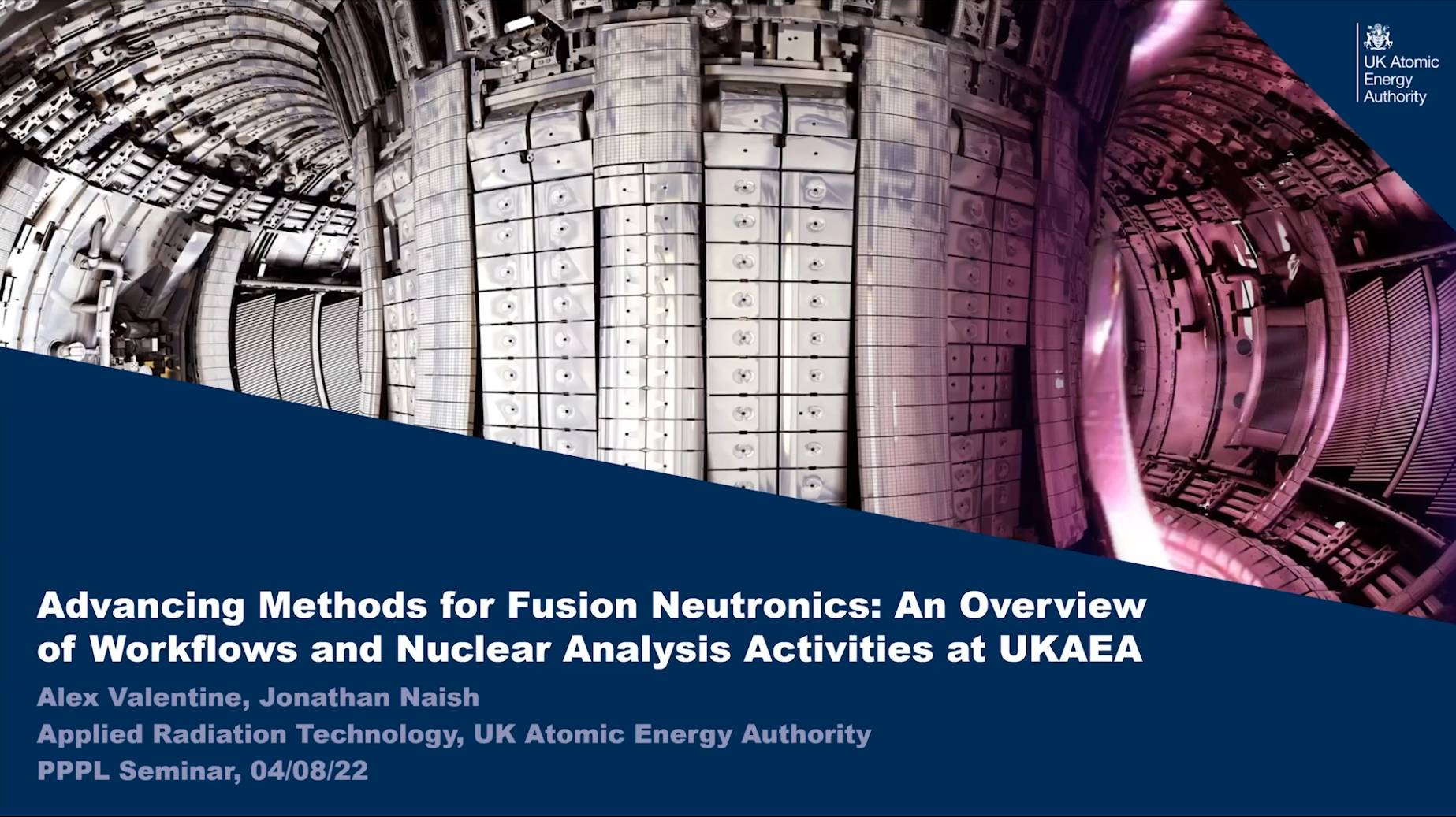
Source: Advancing Methods for Fusion Neutronics: An Overview of Workflows and Nuclear Analysis Activities at UKAEA, PPPL Colloquium.
On 4 August, our Fusion group’s members Ezequiel Goldberg and Martí Circuns i Duxans attended a Princeton Plasma Physics Laboratory (PPPL) colloquium entitled “Advancing Methods for Fusion Neutronics: An Overview of Workflows and Nuclear Analysis Activities at UKAEA” with invited speakers Alex Valentine (Senior Nuclear Radiation Analyst) and Jonathan Naish (Lead for STEP Neutronics) from the UK Atomic Energy Authority (UKAEA).
Ezequiel and Martí found the Colloquium highly interesting, informative and directly relevant to the activities in our group. In particular, within FusionCAT project, we are developing ahigh-fidelity deterministic neutron transport solver called NEUTRO (an exhaustive description of the solver can be found in here) which solves the Boltzmann stationary transport equation. The solver was created within the Alya system: a Finite Element, parallel, multi-physics framework created at BSC designed to solve different physical phenomena in a coupled way.
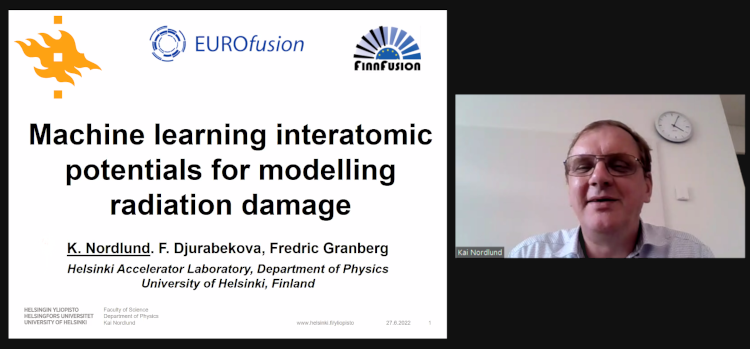
Professor Kai Nordlund from the University of Helsinki gave a Computational Materials Physics talk about fusion reactor materials.
On 27 June, group members Julio Gutiérrez and Mary Kate Chessey attended a Materials Square webinar(#118) titled, “Machine learning interatomic potentials for modelling radiation damage,” with invited speaker Professor Kai Nordlund of Computational Materials Physics from the University of Helsinki, Finland.
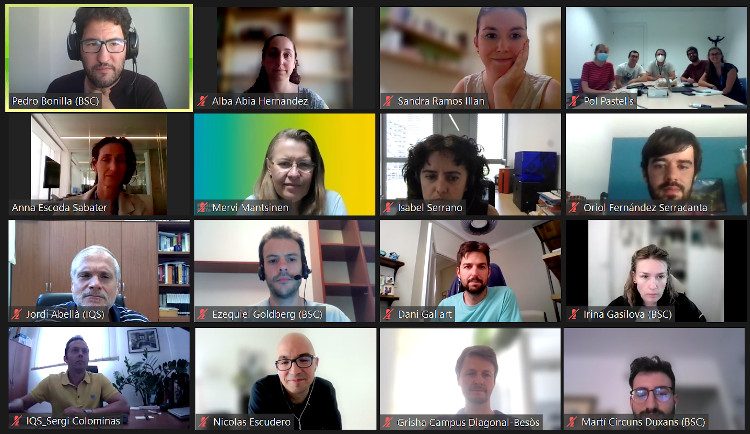
Group photo of the participants on FusionCAT’s technology transfer webinar
On May 30th, our Fusion Group had the pleasure of organizing a training webinar on technology transfer for all the partners of the FusionCAT consortium. After two years of intensive work on several assets within the project, the time to explore collaborations with the industry partners is getting closer. This webinar set the basis for the best exploitation strategies for doing so.