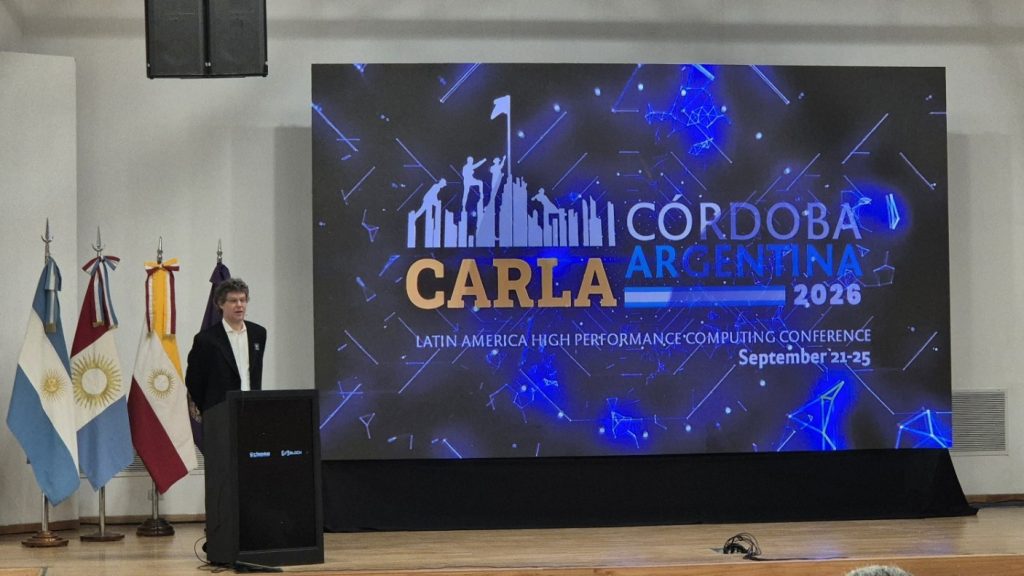
From September 21 to 25, 2026, the BSC Fusion Group participated in the High-Performance Computing in Latin America (CARLA) conference at the Cultural Center of the National University of Córdoba (UNC), Argentina. The event gathered HPC experts to discuss regional and global advancements in supercomputing infrastructure, applications, and networking.
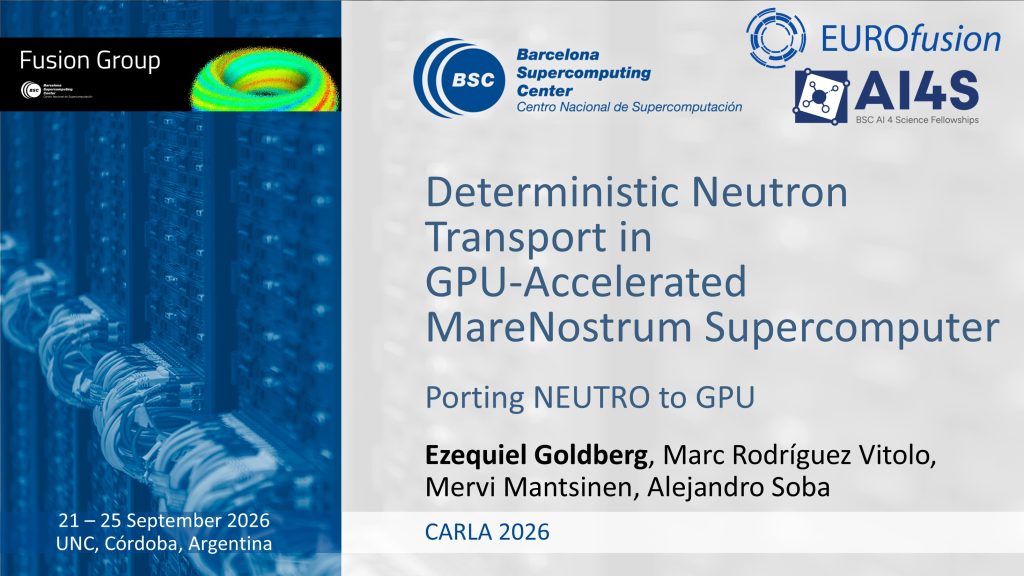
Ezequiel Goldberg presented the group’s recent advancements in a talk titled “Deterministic Neutron Transport in GPU-Accelerated MareNostrum Supercomputer”. The work, co-authored by Marc Rodríguez Vitolo, Mervi Mantsinen, and Alejandro Soba, highlighted critical computational improvements for fusion energy simulations.
Accurate modelling of neutron transport is essential for safety, shielding, and material-fatigue assessments in future reactors like ITER where fusion reactions produce high-energy neutrons that can damage structural materials over time. The presentation detailed the optimization of NEUTRO, a deterministic neutron transport solver integrated into BSC’s Alya multiphysics framework.
To handle the massive number of coupled partial differential equations and the memory-bound nature of the solver, the team ported NEUTRO to run on NVIDIA Hopper GPUs using OpenACC on the MareNostrum 5 supercomputer. The optimization process yielded significant performance milestones:
- The porting stages included vectorization, kernel decomposition, memory access pattern optimization, and scalarization.
- 3.58x speedup was achieved relative to the baseline GPU port.
- Total execution time for the solver dropped from over 18 minutes to 5 minutes and 3 seconds.
- Energy consumption analyses showed that when used effectively, GPUs and accelerators are more energy-efficient than using CPU only.
This research was carried out within the framework of the EUROfusion Consortium and supported by the AI4S fellowship program.
Our focus on reducing power consumption was in line with the event’s broader themes. Throughout the conference, energy efficiency emerged as a recurring topic across multiple talks, reflecting a growing consensus within the HPC community that sustainable computing practices are as critical as raw performance gains.
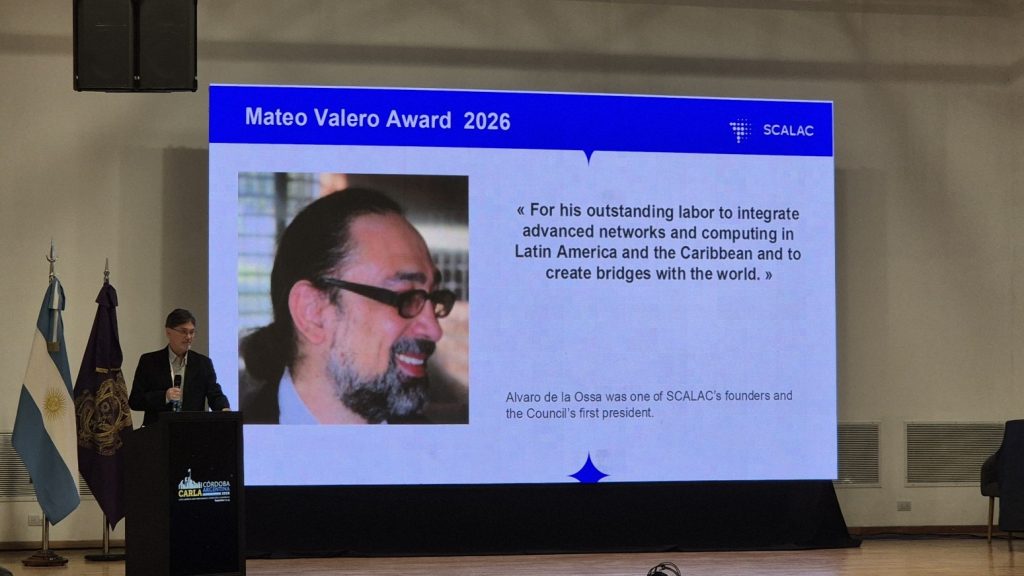
Beyond the technical presentations, the conference featured a significant milestone for BSC’s relationship with the region. The Mateo Valero Award, named in honor of BSC’s director and presented yearly since 2023 (together with the Philippe Navaux Award since 2024), was awarded to Álvaro de la Ossa of the University of Costa Rica. De la Ossa was recognized for his outstanding work integrating advanced networks and computing in Latin America and the Caribbean, and for building bridges with the world as a founding member and first president of SCALAC (Advanced Computing System for Latin America and the Caribbean).