
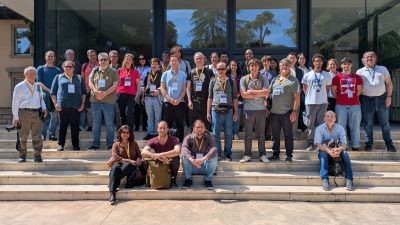
On May 19, the Fusion Group at the Barcelona Supercomputing Center (BSC) welcomed around 60 participants from the 23rd Joint Workshop on Electron Cyclotron Emission and Electron Cyclotron Resonance Heating (EC-23) for a visit to our centre’s facilities.
Held in Barcelona from May 18 to 22, EC-23 brought together members from the international fusion community. The workshop focuses on the interaction of electromagnetic waves in the millimetre range with hot plasmas, covering key topics such as Electron Cyclotron Resonance Heating (ECRH), Electron Cyclotron Current Drive (ECCD), Electron Cyclotron Emission (ECE) diagnostics, and enabling technologies. The event was chaired by Fusion for Energy (F4E), co-chaired by BSC and CIEMAT, and supported by ITER.
During their visit, the EC-23 participants were introduced to the research activities carried out at BSC and to the role of advanced computing technologies in addressing complex scientific challenges, including those associated with fusion energy. The visit also provided an opportunity to present BSC as a multidisciplinary research centre, where high-performance computing supports scientific work in fields ranging from engineering and fusion to life and Earth sciences.
Participants visited MareNostrum 5, the centre’s pre-exascale supercomputer and one of Europe’s leading high-performance computing systems, where they learned about its heterogeneous architecture and its capabilities for scientific simulation and artificial intelligence workloads.
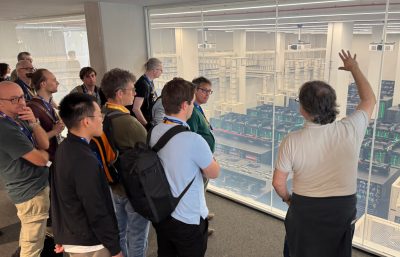
The tour continued in the Torre Girona chapel, where participants were introduced to the BSC AI Factory, an initiative that supports AI innovation in Europe by providing advanced computing resources and expertise to industry, SMEs, and startups. Next, participants could see MareNostrum Ona, the quantum computing infrastructure.
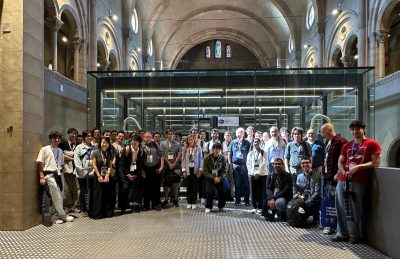
Participants also had the opportunity to watch a video featuring examples of scientific simulations carried out by research groups at BSC. The video illustrated the broad impact of the centre’s computing capabilities across areas such as fusion energy, engineering, life sciences, and Earth sciences, providing a visual overview of how advanced computing contributes to tackling major scientific challenges.
We would like to thank the EC-23 participants for visiting BSC and for giving us the opportunity to introduce them to our research activities and advanced computing infrastructures. The visit was an excellent occasion to demonstrate how high-performance computing, artificial intelligence, and quantum technologies support research across a wide range of scientific fields, including fusion energy.