Stunning simulation of a fusion reactor in operation

Simulation of JET with glass walls in operation (Photo: CCFE)

Culham Centre for Fusion Energy (CCFE) is developing a new simulation tool knwon as CHERAB for forward modelling diagnostics based on spectroscopic plasma emission.

CHERAB is being used by fusion scientists to simulate all sorts of visible and infrared plasma measuring tools, known as diagnostics. The diagnostic systems measure the light output of the plasma to study properties such as its temperature and density. Inferring these properties requires an accurate understanding of how the light is produced and bounces around inside the machine. The more accurately we can model these systems the more accurate our measurements of fusion plasmas will be.


Read more

From EAST to WEST

Over the last few weeks, two important news have been published related to the preparations towards ITER operation. These news are regarding achievements at two experimental fusion reactors that have provided key data for the ITER project and have shown that we are a step closer to produce fusion energy.

Read more

New cloud-based computing platform for fusion research

Since June Culham Centre for Fusion Energy (CCFE) provides a new facility to fusion scientists, named the CUMULUS Modular Data Centre. The centre contains a new cloud-based computing platform that promises to process scientific data quicker, cheaper and more accurately than ever before.

Scientific computing is an essential technology for assimilating and understanding the large quantities of data that are now commonplace in the fusion community, as well as carrying out complex predictive simulations of tokamak plasmas. To give an idea of where we are heading, the next-generation fusion experiment ITER will generate 2 petabytes of raw data each day (2,000 trillion bytes), more than JET has produced in its entire 34-year history!

Read more

Plenary talk on HPC at HTS workshop

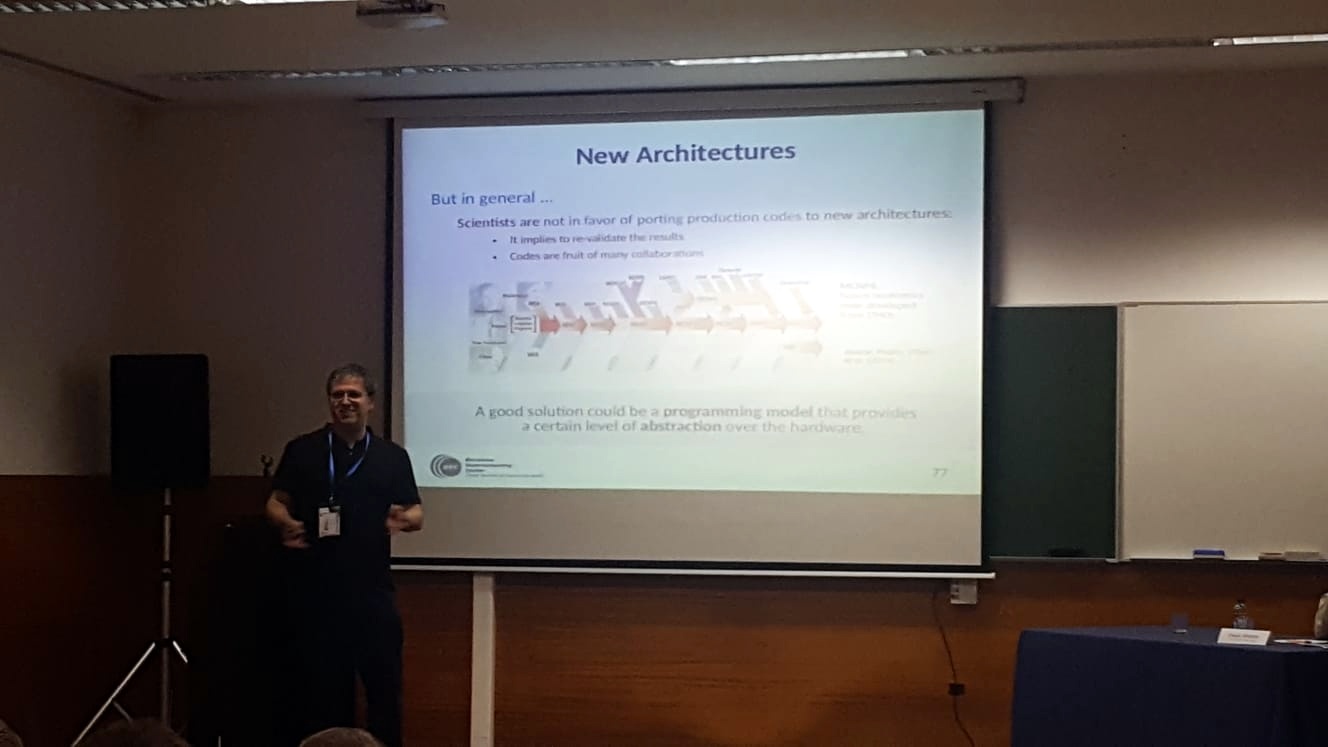
Xavier Sáez.

Our researcher Xavier Sáez gave a plenary talk on “HPC for solving multi-physics problems” at the 6th International Workshop on Numerical Modelling of High-Temperature Superconductors (HTS) in Costa de Caparica, Portugal.

Xavier focused his speech on the importance of multi-physics simulations to capture all relevant phenomena to model and simulate complex systems, and the key role of High-Performance Computing (HPC) due to the high computing resources required in those simulations.

Read more