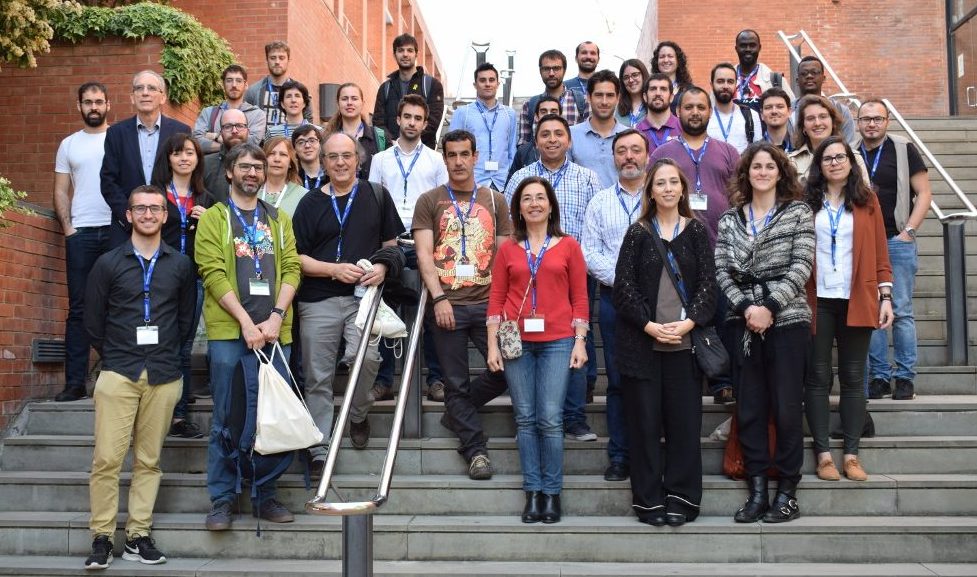
Presentation on TJ-II Alfvénic instabilities at Fast Ions Physics workshop

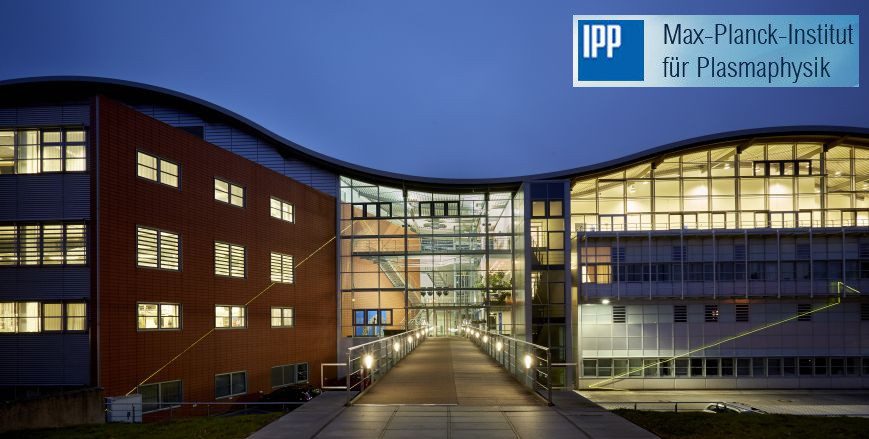
IPP Greifswald, Germany. Photo: heinze.de

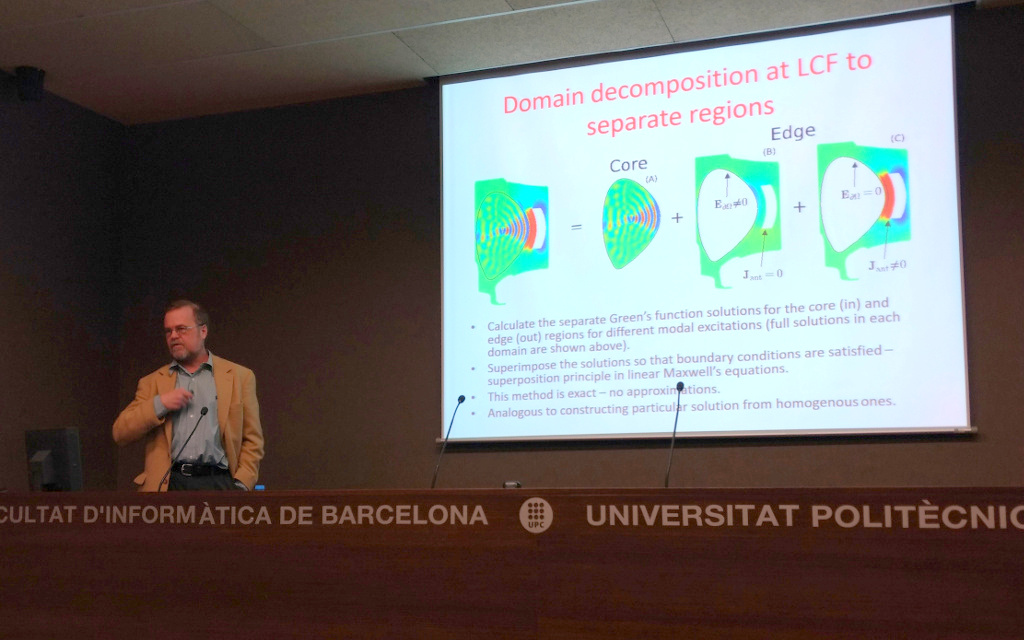
Our PhD student Allah Rakha presented his current work titled “Modelling of Energetic Particle-Driven Alfvénic instabilities in TJ-II plasmas” at Fast Ions Physics workshop (January 22-23, 2018), held at Max-Planck-Institut für Plasmaphysik Teilinstitut Greifswald, Germany.

The fast ion physics workshop was designed for the stellarator fusion community to envisage the studies of energetic particles for up-coming experimental campaign in July 218 at W7X stellarator.

Read more

Join us! We are looking for an Internship student in Computational Modelling for Fusion

BSC team.

The Fusion Group at Barcelona Supercomputing Center (BSC) is looking for an internship student with a degree in physics or computer science. The successful candidate will become an active member of the group. The group is a multidisciplinary team that includes mathematicians, physicists and computer scientists. The research project will be decided based on the research interests of the successful candidate and the needs of the projects.

Read more

New recipe proposed for fusion: Fusing Quarks

The Large Hadron Collider (LHC). Photo: CERN

Whether the nuclear fusion approach is based upon magnetically confined plasmas or inertial confinement, the underlying idea is the same, to fuse nuclei made up of protons and neutrons into a more massive nucleus. But what if there exists other physical mechanisms?

A recent paper published in Nature by Marek Karliner and Jonathan L. Rosner describes the fusion reaction at a quark-level by the double charmed baryon discovered at CERN, Geneva. CERN hosts the Large Hadron Collider (LHC) which is the world’s largest and most powerful particle collider which intends to discover the fundamental structure of the universe.

Read more