Over the last few weeks, two important news have been published related to the preparations towards ITER operation. These news are regarding achievements at two experimental fusion reactors that have provided key data for the ITER project and have shown that we are a step closer to produce fusion energy.
Since June Culham Centre for Fusion Energy (CCFE) provides a new facility to fusion scientists, named the CUMULUS Modular Data Centre. The centre contains a new cloud-based computing platform that promises to process scientific data quicker, cheaper and more accurately than ever before.
Scientific computing is an essential technology for assimilating and understanding the large quantities of data that are now commonplace in the fusion community, as well as carrying out complex predictive simulations of tokamak plasmas. To give an idea of where we are heading, the next-generation fusion experiment ITER will generate 2 petabytes of raw data each day (2,000 trillion bytes), more than JET has produced in its entire 34-year history!
We are delighted to announce that Xavier Sáez from our Fusion Group has been selected as a High Level Support Team (HLST) member by the General Assembly of EUROfusion after a call for candidates that was issued in March. This news reinforces the link between Barcelona Supercomputing Center (BSC) and EUROfusion in the fusion research as an energy source.
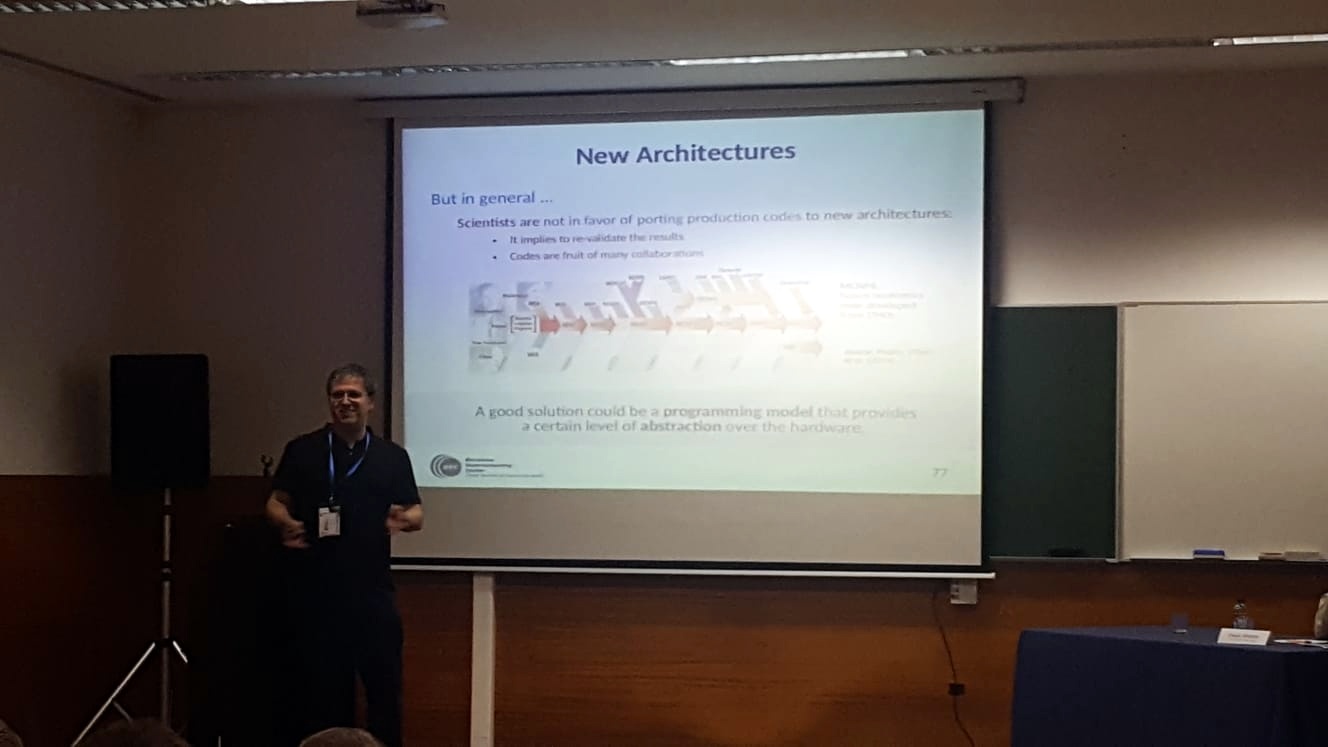
Xavier focused his speech on the importance of multi-physics simulations to capture all relevant phenomena to model and simulate complex systems, and the key role of High-Performance Computing (HPC) due to the high computing resources required in those simulations.
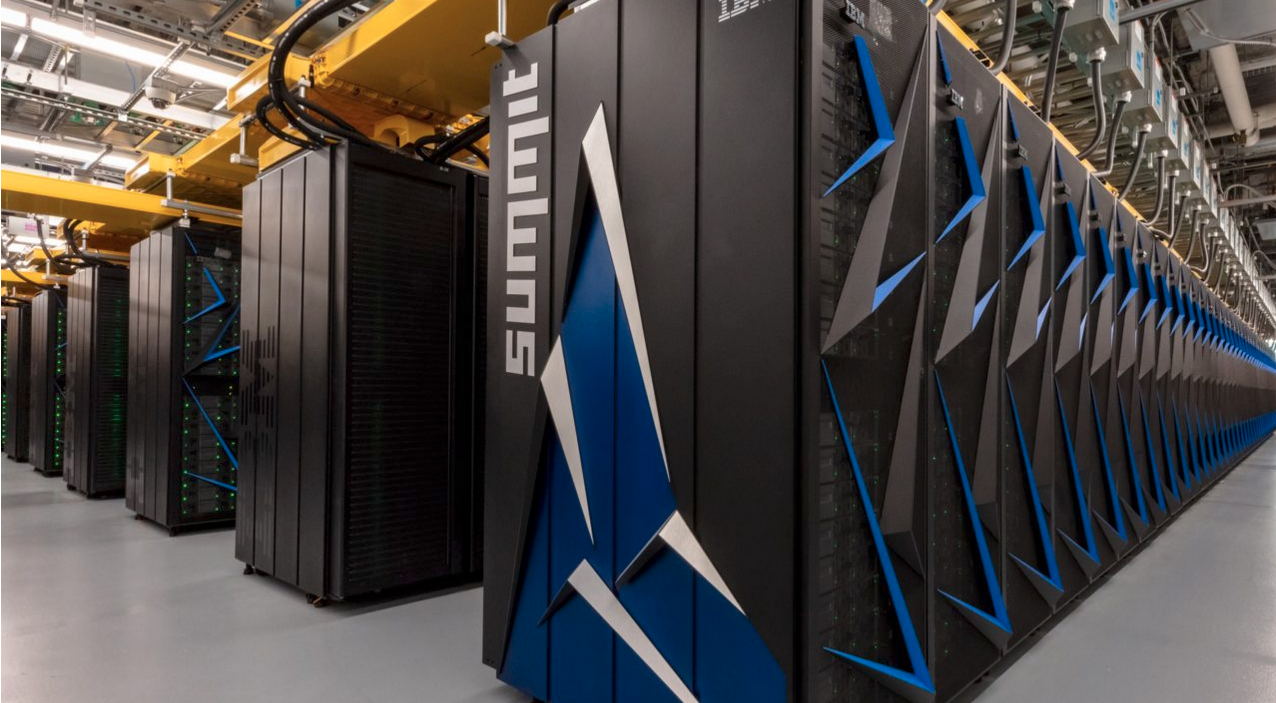
The Summit supercomputer hosted at the US Department of Energy’s Oak Ridge National Laboratory (ORNL) has been announced as the fastest supercomputer in the world, according to the TOP500 List.
The IBM Summit system reached a speed of 122.3 petaflops on the High-Performance Linpack benchmark test—the software used to evaluate and rank supercomputers on the TOP500 list. At its theoretical peak, Summit is capable of 200 petaflops (double precision), or 200 quadrillion calculations per second, about eight times more performance than its predecessor Titan.
Simulation of the neutron flux inside a fusion tokamak reactor building. The white area at the centre is occupied by the fusion reactor. Photo: iter.org
In the process of fusion energy production based hydrogen heavy isotopes deuterium and tritium as fuel, high-energy neutrons are released. These neutrons have many roles in a fusion reactor.
On one side, neutrons from the fusion reactions taking place in the fuel inside the reactor vacuum vessel generate the heat that, in a fusion plant, will initiate the electricity-producing process. Moreover, neutron interaction with lithium inside the machine will produce tritium.