
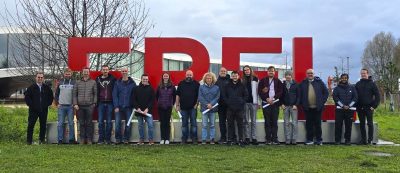
On November 25–26, the 3rd Annual Meeting of EUROfusion HPC ACHs took place in Lausanne (Switzerland), hosted by EPFL, further consolidating the series of yearly gatherings. The BSC-CIEMAT ACH was represented by fusion group members Alejandro Soba, Federico Cipolletta, Augusto Maidana and Xavier Sáez, together with Joan Vinyals from the Best Practices for Performance and Portability (BPPP) group, actively contributing to the discussions and technical exchange throughout the event. This third edition has confirmed that this yearly event among ACHs has been an important step toward sharing results, lessons learned, and jointly planning future work.
The EUROfusion Advanced Computing Hubs (ACHs) are teams dedicated to supporting European fusion physicists to improve the performance of their simulation codes (for example, by parallelizing them, porting them to GPUs, optimizing algorithms, etc.).
As these hubs are distributed across different countries (Finland, Germany, Spain, and Switzerland), the annual meetings have become a key coordination space within EUROfusion, supporting knowledge exchange between the different hubs and aligning efforts to find solutions to common challenges across them. Additionally, each edition typically rotates the host location among the different hubs, taking the opportunity to visit local facilities (computing centers, fusion laboratories, etc.) and to strengthen the collaboration network between institutions.
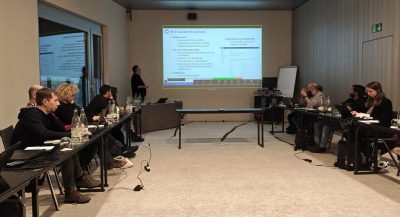
The two-day meeting featured concise technical updates from all ACHs. EPFL ACH presented progress on GPU porting, portable libraries for exascale simulations, improvements in plasma turbulence modeling, data-handling optimization, modernization of legacy codes and implementation on visualization tools. The BSC-CIEMAT ACH team reported advances in hybrid parallelization, support for multiple fusion codes, performance monitoring tools and GPU acceleration for plasma–wall interaction and gyrokinetic applications.
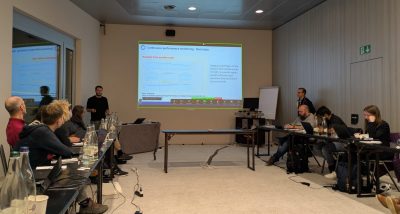
On the second day, the IPP-MPG ACH hub provided updates on HPC infrastructure benchmarking, numerical enhancements in key plasma physics codes and new approaches for RF simulations. Contributions from VTT-Finland ACH covered scalable Monte-Carlo methods for neutral transport and performance studies of OpenMP GPU offloading. The complete meeting agenda and all presentation files are available on the event’s Indico page.
In addition to the technical sessions, participants had the opportunity to visit the TCV tokamak at the Swiss Plasma Center facilities (SPC). The Tokamak à Configuration Variable (TCV) is one of Europe’s most versatile experimental fusion devices due to its flexibility in setting its plasma shape.

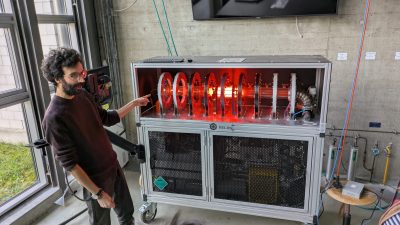
The tour included a demonstration of the “Helios” project, which is a compact platform capable of producing Neon and Argon plasmas, with the possibility of applying a longitudinal magnetic field to visualize how plasma propagates along magnetic field lines.
The programme also featured a guided visit to EPFL’s thermal power plant, located on the same Lausanne campus. Built in 1978 to draw thermal energy from Lake Geneva, the installation supplies cooling and heating for the campus and also cools the Data Center. After a major renovation, the plant now operates fully without oil, reducing EPFL’s carbon emissions and showcasing a successful example of sustainable energy technology.
Finally, we would like to express our sincere gratitude to EPFL for their excellent organisation and warm hospitality throughout the event. We hope to see you at the next event in Garching, Germany!