
Evidence of generation of non-inductive toroidal plasma current above density limit

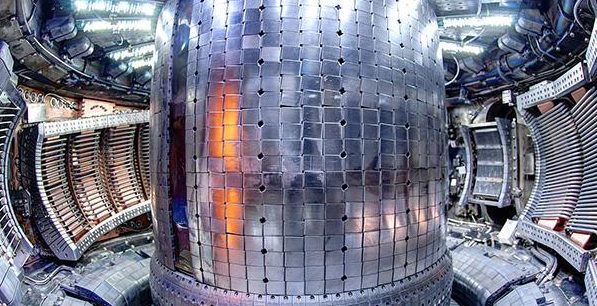
Alcator C-Mod (Photo: Courtesy of MIT)

One of the key requirements to achieve steady-state power production in a fusion reactor based on the so-called tokamak configuration is to generate non-inductive toroidal plasma current in an efficient way. A recent paper published in Physical Review Letters entitled Observation of Efficient Lower Hybrid Current Drive at High Density in Diverted Plasmas on the Alcator C-Mod Tokamak reports on the use of lower hybrid current drive (LHCD) as an efficient mean to obtain non-inductive plasma current at high plasma densities in a diverted tokamak configuration such as Alcator C-Mod.
Read more

New cloud-based computing platform for fusion research

Since June Culham Centre for Fusion Energy (CCFE) provides a new facility to fusion scientists, named the CUMULUS Modular Data Centre. The centre contains a new cloud-based computing platform that promises to process scientific data quicker, cheaper and more accurately than ever before.

Scientific computing is an essential technology for assimilating and understanding the large quantities of data that are now commonplace in the fusion community, as well as carrying out complex predictive simulations of tokamak plasmas. To give an idea of where we are heading, the next-generation fusion experiment ITER will generate 2 petabytes of raw data each day (2,000 trillion bytes), more than JET has produced in its entire 34-year history!

Read more