
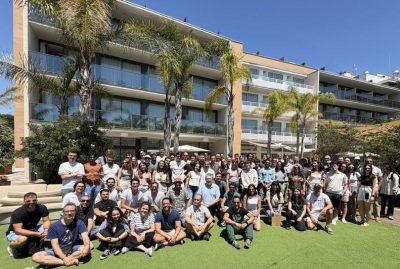
Fusion energy research increasingly relies on advanced computational capabilities. At the Fusion Group at the Barcelona Supercomputing Center (BSC), we develop and optimise scientific software to help address these challenges — from large-scale simulations and numerical methods to HPC performance and emerging computing architectures. We are now looking for new colleagues to join our team.
Computing for fusion
The development of fusion energy requires increasingly sophisticated computational tools. Large-scale simulations, multiphysics modelling and integrated workflows are essential for understanding plasma behaviour, designing fusion technologies and interpreting experiments.
At the Fusion Group at BSC, our work focuses on strengthening these computational capabilities through scientific code development, validation, integration and optimisation, making use of advanced high-performance computing technologies. As part of the EUROfusion Advanced Computing Hub (ACH) at BSC, we work at the intersection of fusion science, scientific software and high-performance computing. A particular focus is on optimising and porting scientific codes to new and heterogeneous computer architectures, including GPU-based systems. This involves challenges across several levels — from numerical methods and algorithms to parallel programming, software engineering, performance analysis and the integration of different physics models.
Working in the European fusion programme
The Fusion Group is part of the Computer Applications in Science and Engineering (CASE) Department at BSC and works closely with the European fusion programme. Our activities contribute to the objectives of EUROfusion and are carried out in collaboration with organisations including Fusion for Energy (F4E), ITER and CIEMAT. We provide an international and interdisciplinary environment in which expertise in fusion physics, computational science, numerical methods, scientific software and HPC comes together.
We are looking for new colleagues
We currently have two positions open in the Fusion Group, aimed at different career stages:
- Researcher (R2) position, aimed at candidates with a PhD in computational physics, computer science, engineering or a related field, together with relevant research experience. The successful candidate will participate in R&D activities within the EUROfusion Advanced Computing Hub, with a particular focus on optimising and porting scientific codes to new computer architectures. Relevant experience includes scientific computing, numerical methods, code development and HPC. Programming experience in C, C++, Fortran, MPI, OpenMP, OpenACC and CUDA, as well as experience with GPU enabling and performance analysis, is particularly relevant.
- Research Engineer (RE2) position, aimed at candidates with an MSc in computational physics, computer science, engineering or a related field, together with relevant professional experience. The position focuses on research engineering activities within the EUROfusion Advanced Computing Hub, including scientific software development, optimisation and porting to new computer architectures. Experience in programming and debugging, HPC, heterogeneous architectures, GPU enabling and performance analysis is relevant. Experience in software development and delivery, continuous integration, refactoring, user support and working in interdisciplinary teams is also desirable.
More than a list of technologies
Although the positions involve technologies such as MPI, OpenMP/OpenACC and CUDA, we are looking for more than a particular set of programming skills. Our work involves complex scientific and engineering problems, and we value people who enjoy understanding problems at a deeper level, working collaboratively and learning new approaches and technologies. The vacancies are deliberately broad in this respect. Candidates do not need to have experience in every area listed in the job descriptions. We encourage applications from candidates who do not meet all the requirements, recognising the diversity of experience and skills that people can bring to a team.
Join us
If you are interested in scientific computing, HPC, scientific software, GPU technologies and fusion, and would like to contribute to computational research within the European fusion programme, we would be very happy to hear from you.
- Researcher (R2) – find out more and apply here.
- Research Engineer (RE2) – find out more and apply here.
Please feel free to share these opportunities with colleagues, students and potential candidates who may be interested.