Evidence of generation of non-inductive toroidal plasma current above density limit

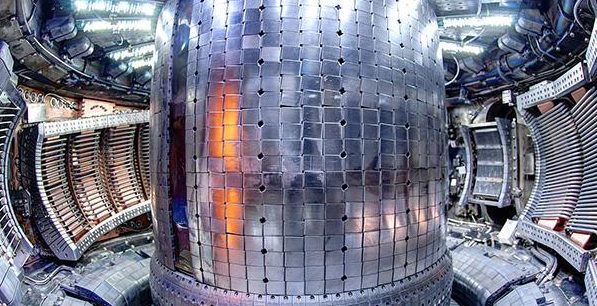
Alcator C-Mod (Photo: Courtesy of MIT)

One of the key requirements to achieve steady-state power production in a fusion reactor based on the so-called tokamak configuration is to generate non-inductive toroidal plasma current in an efficient way. A recent paper published in Physical Review Letters entitled Observation of Efficient Lower Hybrid Current Drive at High Density in Diverted Plasmas on the Alcator C-Mod Tokamak reports on the use of lower hybrid current drive (LHCD) as an efficient mean to obtain non-inductive plasma current at high plasma densities in a diverted tokamak configuration such as Alcator C-Mod.
Read more

New cloud-based computing platform for fusion research

Since June Culham Centre for Fusion Energy (CCFE) provides a new facility to fusion scientists, named the CUMULUS Modular Data Centre. The centre contains a new cloud-based computing platform that promises to process scientific data quicker, cheaper and more accurately than ever before.

Scientific computing is an essential technology for assimilating and understanding the large quantities of data that are now commonplace in the fusion community, as well as carrying out complex predictive simulations of tokamak plasmas. To give an idea of where we are heading, the next-generation fusion experiment ITER will generate 2 petabytes of raw data each day (2,000 trillion bytes), more than JET has produced in its entire 34-year history!

Read more

Wendelstein 7-X achieves a stellarator world record

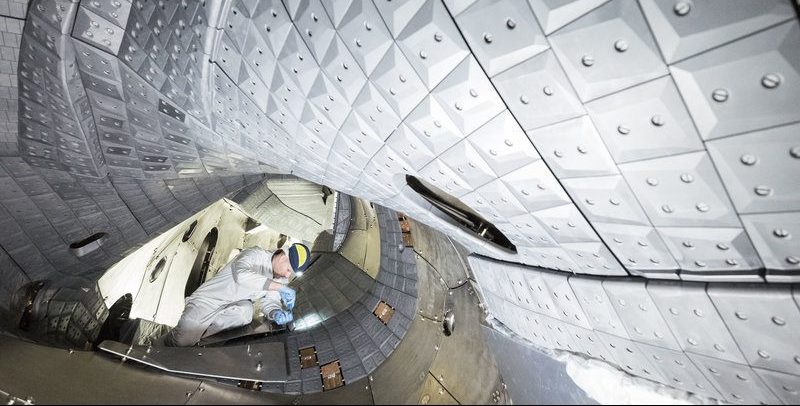
Inside view the plasma vessel with graphite tile cladding. Photo: IPP

In the past experimentation round, Wendelstein 7-X achieved the stellarators’ world record for the fusion product as a result of reaching higher temperatures and densities of the plasma as well as longer pulses. Wendelstein 7-X attained a fusion product of 6·1026 degrees x second per cubic metre which is the world’s stellarator record and gives first confirmation that the optimisation carried out for its design has been successful.

Read more

Spain and Croatia push the candidature of Granada for IFMIF-DONES

Pedro Duque and Blazenka Divjak after signing the agreement on IFMIF-DONES. Photo: CIEMAT news.

Science and Research Ministers from Spain and Croatia, Pedro Duque and Blazenka Divjak, have signed a cooperation agreement pushing the candidature of Granada (Spain) for IFMIF-DONES facility.

Spain and Croatia presented initially independent candidatures but they joined their efforts in order to present a common European candidature. IFMIF-DONES aims to study the extreme conditions of fusion materials under energy production and particularly research on irradiation for DEMO operation. The estimated budget for the construction is between 400 and 600 million euros and the construction will take 10 years and it will be operating at least 20 years.

Read more

Barcelona Energy Days – The Energy Transition

The European Union leads the clean-energy transition, aiming to reduce its greenhouse-gas emissions in 2050 by 80-95% from 1990 levels, which means almost decarbonising its energy system. The strategies for this transition were discussed today at the Energy Transition Conference in Barcelona organized jointly by the local UPC Barcelona-Tech University, Fusion for Energy, the Government of Catalonia and the municipalities of Barcelona and Sant Adrià de Besòs.

Read more

On the modelling of neutron transport in a fusion reactor

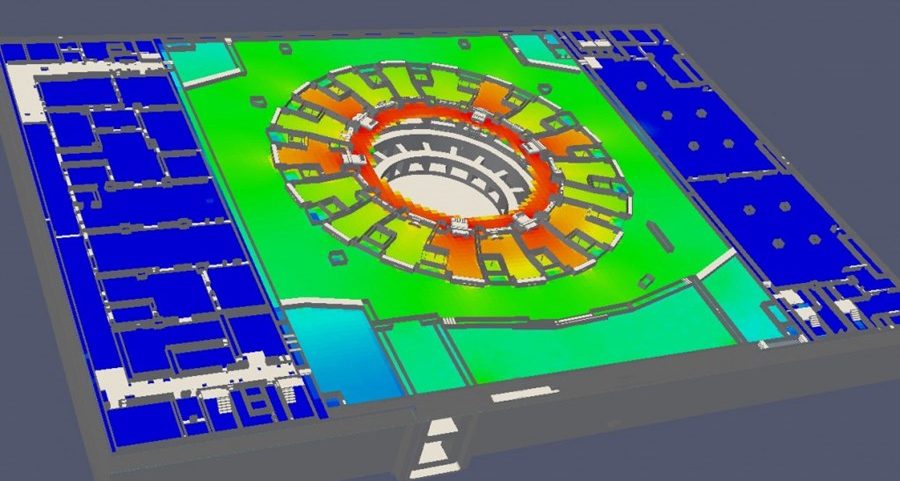
Simulation of the neutron flux inside a fusion tokamak reactor building. The white area at the centre is occupied by the fusion reactor. Photo: iter.org

In the process of fusion energy production based hydrogen heavy isotopes deuterium and tritium as fuel, high-energy neutrons are released. These neutrons have many roles in a fusion reactor.

On one side, neutrons from the fusion reactions taking place in the fuel inside the reactor vacuum vessel generate the heat that, in a fusion plant, will initiate the electricity-producing process. Moreover, neutron interaction with lithium inside the machine will produce tritium.

Read more